

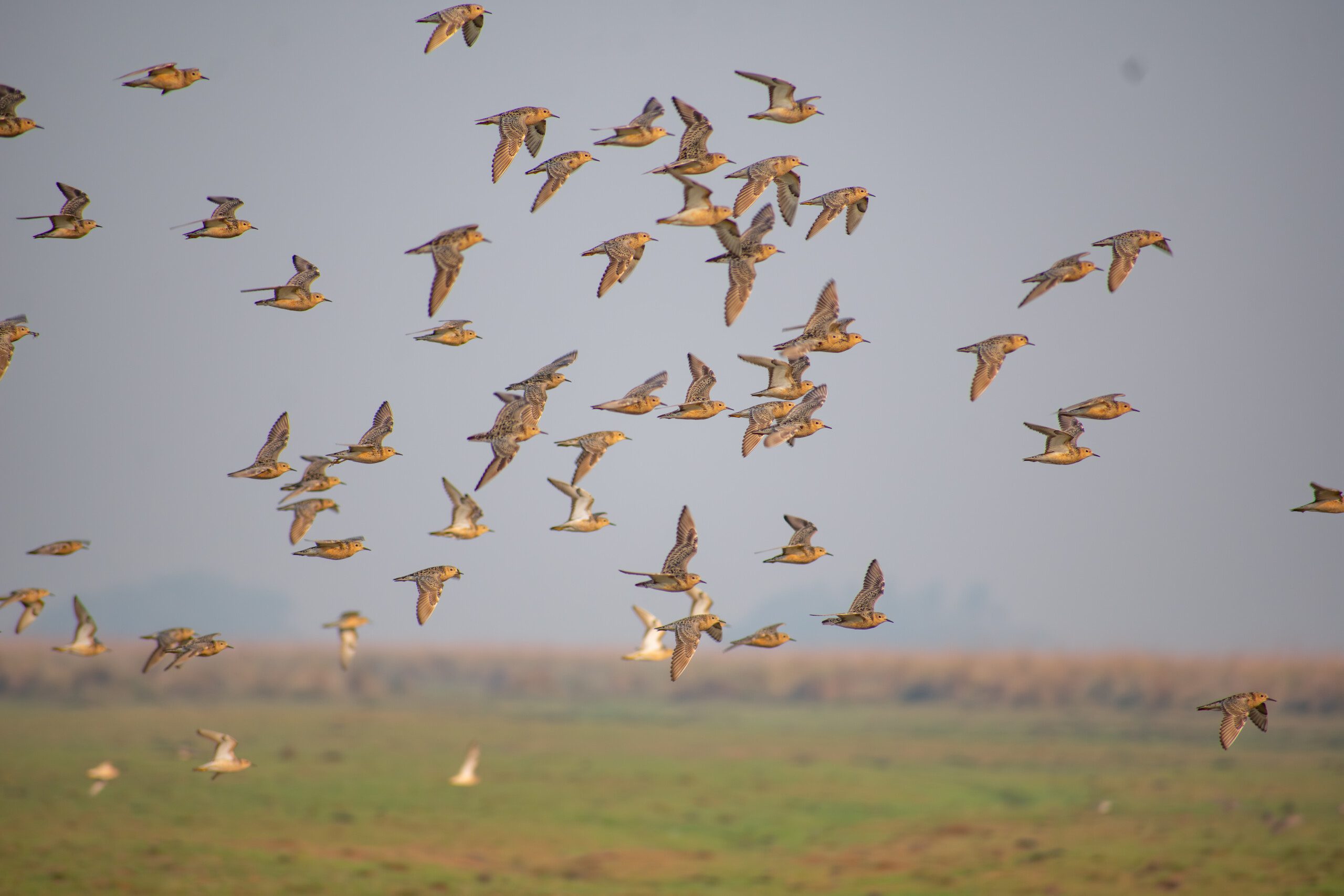
Photo: Teodoro Camacho. Buff-breasted Sandpipers are considered the marathon runners of the natural world.
The Bolivian Beni Grasslands, locally known as Llanos de Moxos are one of the busiest stopover sites for the travelers of the sky. It is estimated that nearly four out of every ten Buff-breasted Sandpipers (Calidris subruficollis) in the global population use this natural corridor during their southward migration. This is no minor figure: if confirmed, the flooded savannas of Beni could be designated a site of hemispheric importance for the conservation of this species.
This is revealed by the long-distance shorebird monitoring study, whose fieldwork was carried out from September 1 to 15, 2025, by Asociación Armonía, with support from the Manomet Conservation Sciences, the Neotropical Migratory Bird Conservation Act (NMBCA) Program of the U.S. Fish and Wildlife Service, and the U.S. Forest Service.
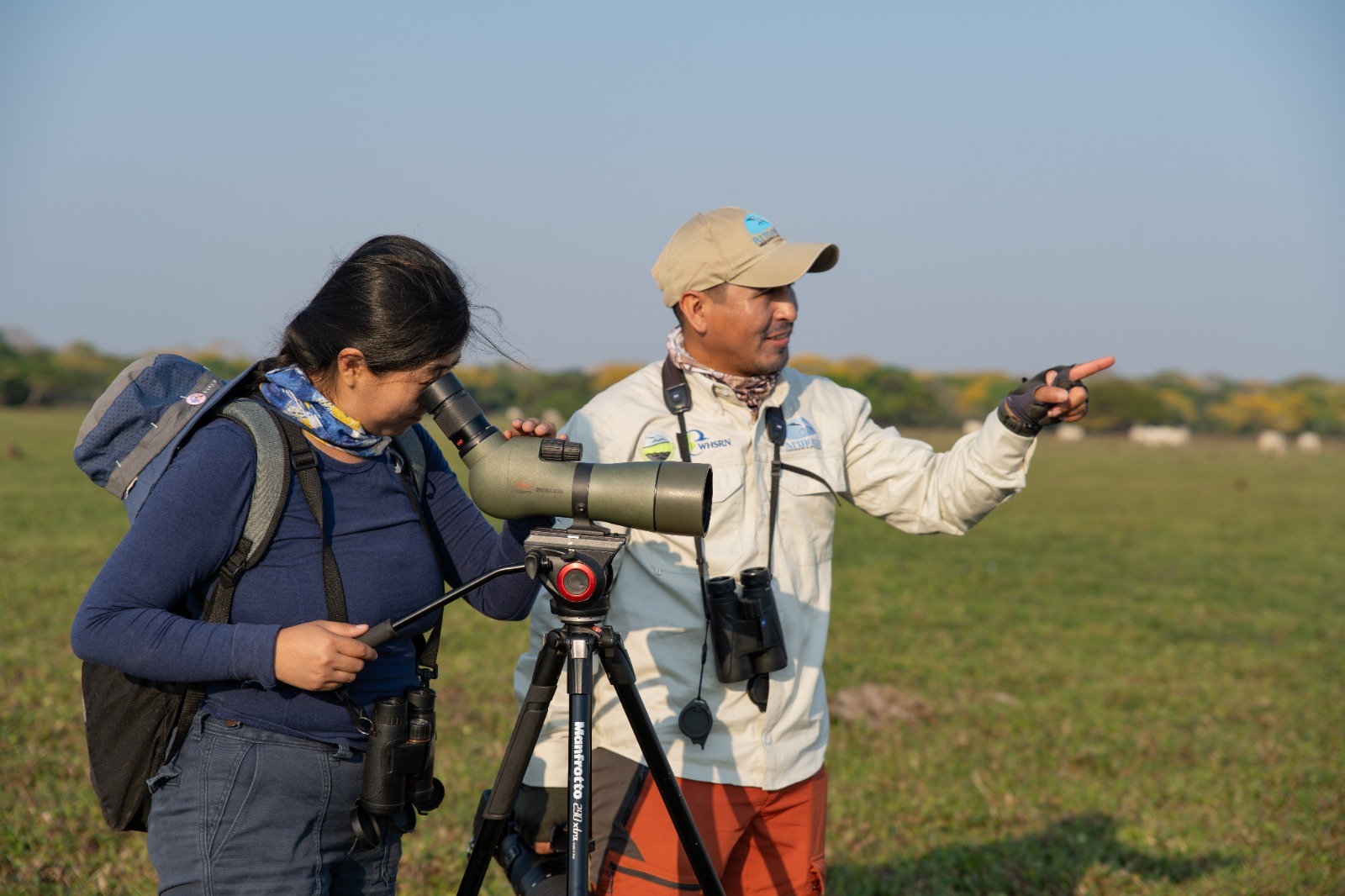
Photo: Marizol Huarachi Colomi. Biologists Teodoro Camacho and Sofía Lottersberger conduct the long-distance shorebird monitoring study in September 2025.
The Buff-breasted Sandpiper, one of the most tireless travelers in the natural world, is a migratory bird that every year undertakes the incredible feat of crossing continents to escape the low temperatures and extreme conditions of Canada, where it breeds. In an effort to survive, it travels from the Arctic to the Southern Cone, covering nearly 29,000 kilometers on its round trip.
But for this journey to succeed, it must stop at key locations along its route. In Bolivia, one of these stopover sites is the Llanos de Moxos, the world’s third-largest savanna, covering approximately 120,000 square kilometers. There, the birds “refuel” by feeding before continuing their journey southward, explains Mariana Villegas, Armonía’s science coordinator.
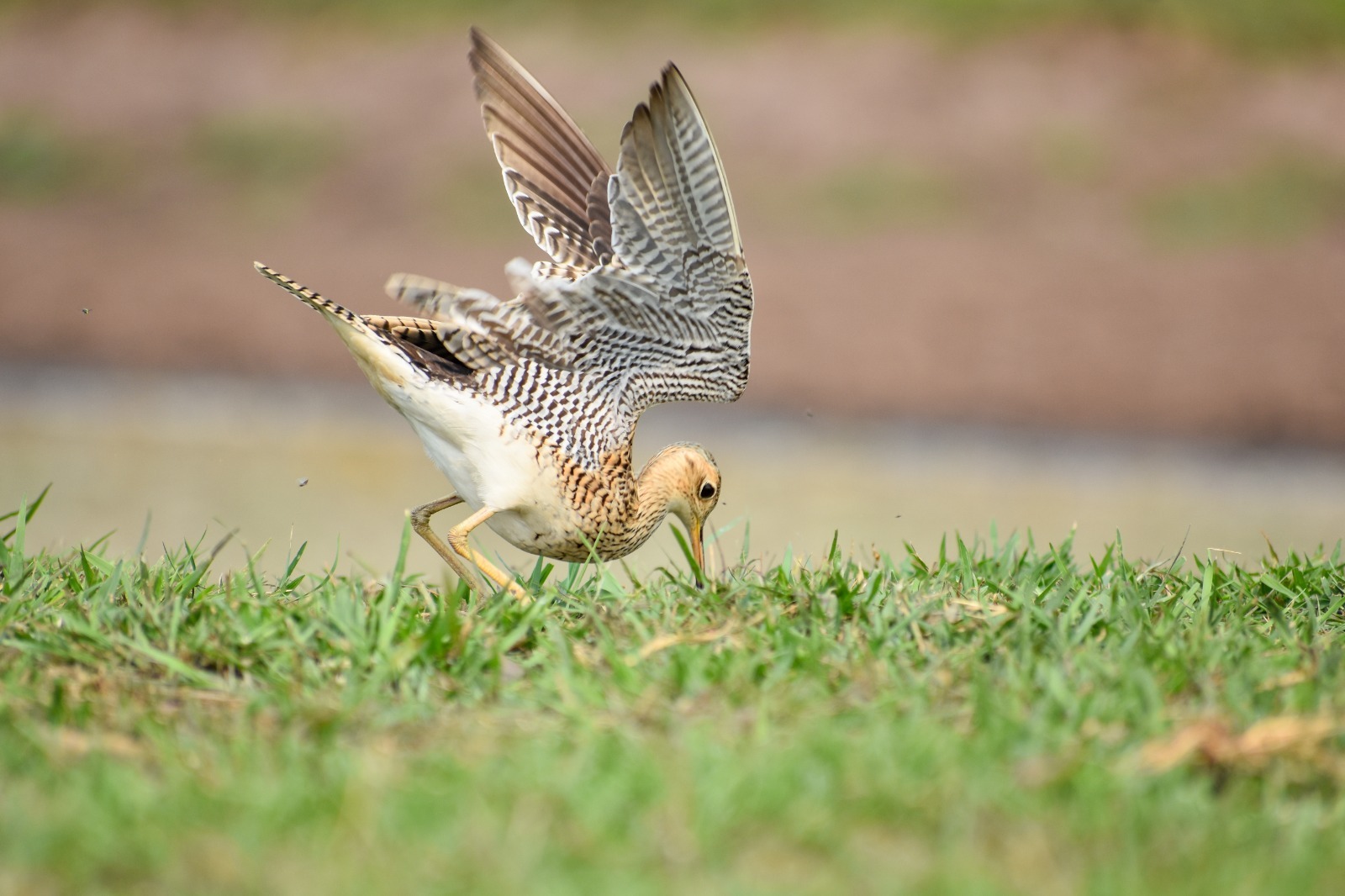
Photo: Teodoro Camacho. The Llanos de Moxos are one of the key stopover sites for the Buff-breasted Sandpiper.
Since 2014, Armonía has carried out this annual survey at the Barba Azul Nature Reserve. However, in 2025, the study was expanded for the first time to three additional areas within the same landscape. Additionally, we surveyed large Amazonian rivers, the Madre de Dios and Mamoré, to evaluate the use of sandbanks. This expanded scope not only provided a better understanding of the territory but also put its importance into a global context.
The Buff-breasted Sandpiper is estimated to have a global population of 56,000 individuals. One of the most important criteria for a site to be considered of hemispheric importance within the Western Hemisphere Shorebird Reserve Network (WHSRN) is that it must support more than 30% of the total population, or at least 16,800 individuals. According to the findings of this latest study, the Llanos de Moxos meet this condition, as they could host as many as 22,891 Buff-breasted Sandpipers.
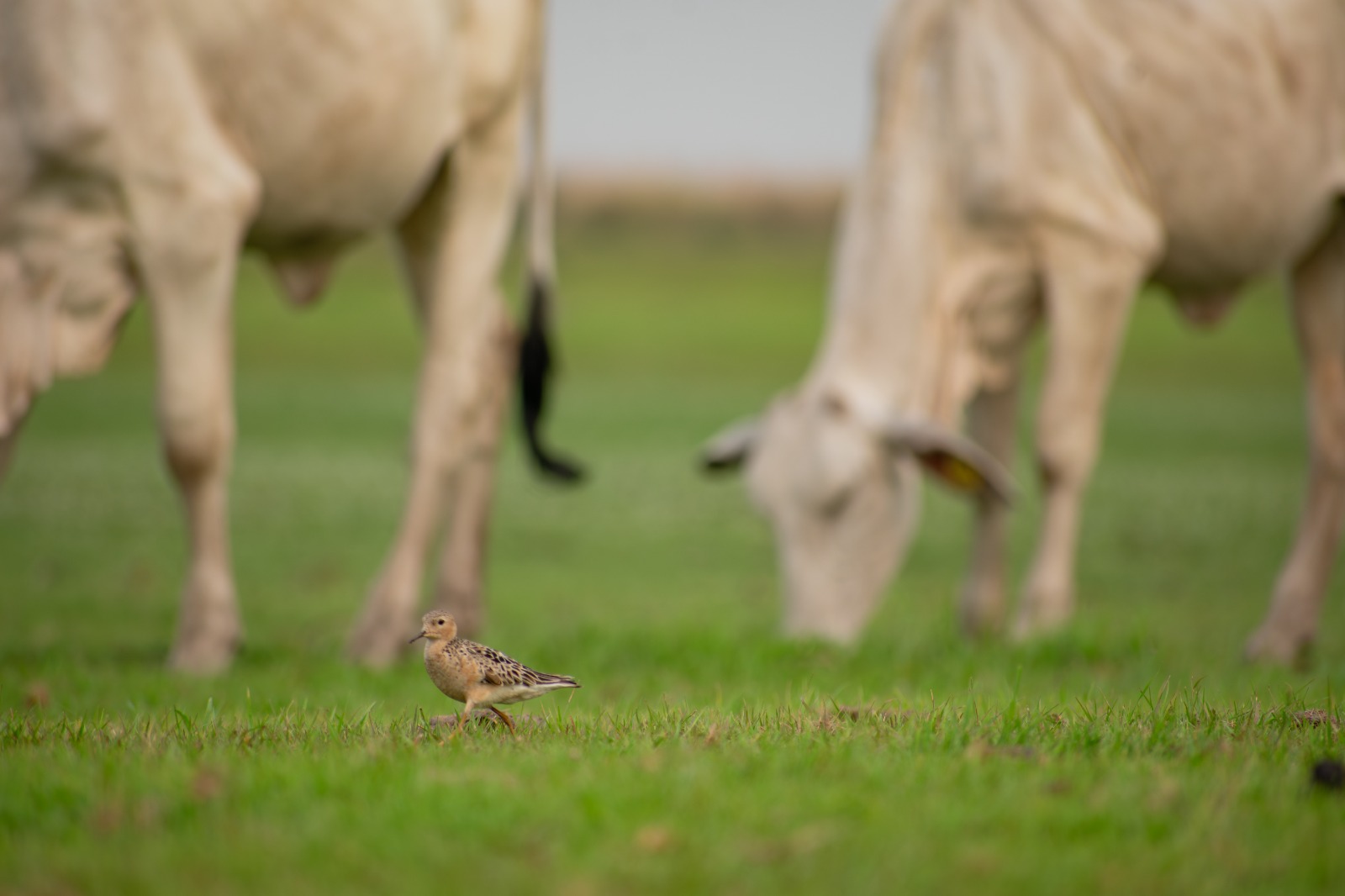
Photo: Teodoro Camacho. Short grass, maintained through sustainable ranching practices at the Barba Azul Nature Reserve, facilitates Buff-breasted Sandpiper foraging habitat.
For an approximate 2-month 63-day migration period, the average total numbersvalues range from 10,969 to 22,891 individuals based on our landscape study. for the same lengths of stay,” the document states. For an approximate 2-month migration period, the average total numbers range from 10,969 to 22,891 individuals based on our landscape study. Additionally, over many years, Buff-breasted Sandpipers have been tagged with GPS trackers, and 100% of all tracked individuals used the Llanos de Moxos as a stopover, leading us to believe that 40% is an underestimate.
Within that landscape, we have evaluated critical sites of importance for the Buff-breasted Sandpiper. One example is the Barba Azul Nature Reserve, which alone supports more than 4% of the world’s Buff-breasted Sandpiper population, making it Bolivia’s only WHSRN site of regional importance.
How was the study conducted?
To arrive at these estimates, the researchers combined fieldwork, statistical modeling, and analysis of previous data. During the first two weeks of September 2025, the teams conducted systematic counts in shortgrass habitats used by the species across four locations, recording not only the number of birds but also variables such as grass height, time of day, and the presence of livestock.
These data made it possible to estimate the species’ daily abundance at the sampled sites. The results were then extrapolated to other unsurveyed bajíos previously identified through a landscape mapping project carried out by Asociación Armonía in collaboration with Manomet in 2021. These data were supplemented with information from an earlier shorebird study conducted along Amazonian rivers—such as the Mamoré and Madre de Dios—in 2023, which also estimated the species’ daily presence.

Photo: Teodoro Camacho. The Barba Azul Nature Reserve supports more than 4% of the world’s Buff-breasted Sandpiper population and is therefore considered a site of regional importance within WHSRN.
Using all this information, the scientists built migration models that take into account how long the birds remain in the region and the total length of the migration season. This made it possible to calculate not only how many birds are present on a given day, but also how many use the Llanos de Moxos over the course of the entire season.
The results show that, depending on the scenarios—such as the length of stay or the duration of the migration period—the total number of Buff-breasted Sandpipers passing through this ecosystem may range from 7,835 to 22,891 individuals.
A key ecosystem for migration
Another finding of the study confirms that the Buff-breasted Sandpiper shows a clear preference for short grasslands, where it can feed more easily.
“We found,” the study specifies, “that the probability of detection was influenced by grass height and the presence of livestock. Grass height was particularly important for the species’ abundance, which was significantly higher in areas with short grass (less than approximately 8 cm). This result is consistent with previous studies in the Barba Azul Nature Reserve grasslands. Short-grass areas likely provide the ideal feeding opportunities, as well as easier detection of and access to prey for Buff-breasted Sandpipers.”
According to Villegas, this condition is maintained in the Llanos de Moxos through livestock management. “It needs to be rotational ranching, rather than concentrating thousands of head of cattle in a single area. Cattle help keep the grass at the right height for the Buff-breasted Sandpiper, but if they remain in the same place for too long, they can compact the soil and degrade the grasslands,” she explains. “That is why it is important to move them from one pasture to another. This rotational management is already being implemented at the Barba Azul Nature Reserve